

It’s 3 AM, and your mind is racing. You’re replaying that conversation from work, catastrophizing about tomorrow’s presentation, or worrying about something you can’t even name. Your chest feels tight, your thoughts are spiraling, and sleep feels impossible.
If this sounds familiar, you’re not alone. Anxiety affects millions of people, but here’s the good news: Cognitive Behavioral Therapy (CBT) offers proven, practical techniques you can start using right now to interrupt anxious thinking and regain control.
Research shows that CBT is effective for 50-75% of people with anxiety disorders, with some studies demonstrating even higher success rates. Unlike medication, which can take weeks to work, or traditional talk therapy, which focuses on exploring the past, CBT gives you actionable tools to change your thoughts and behaviors in the present moment.
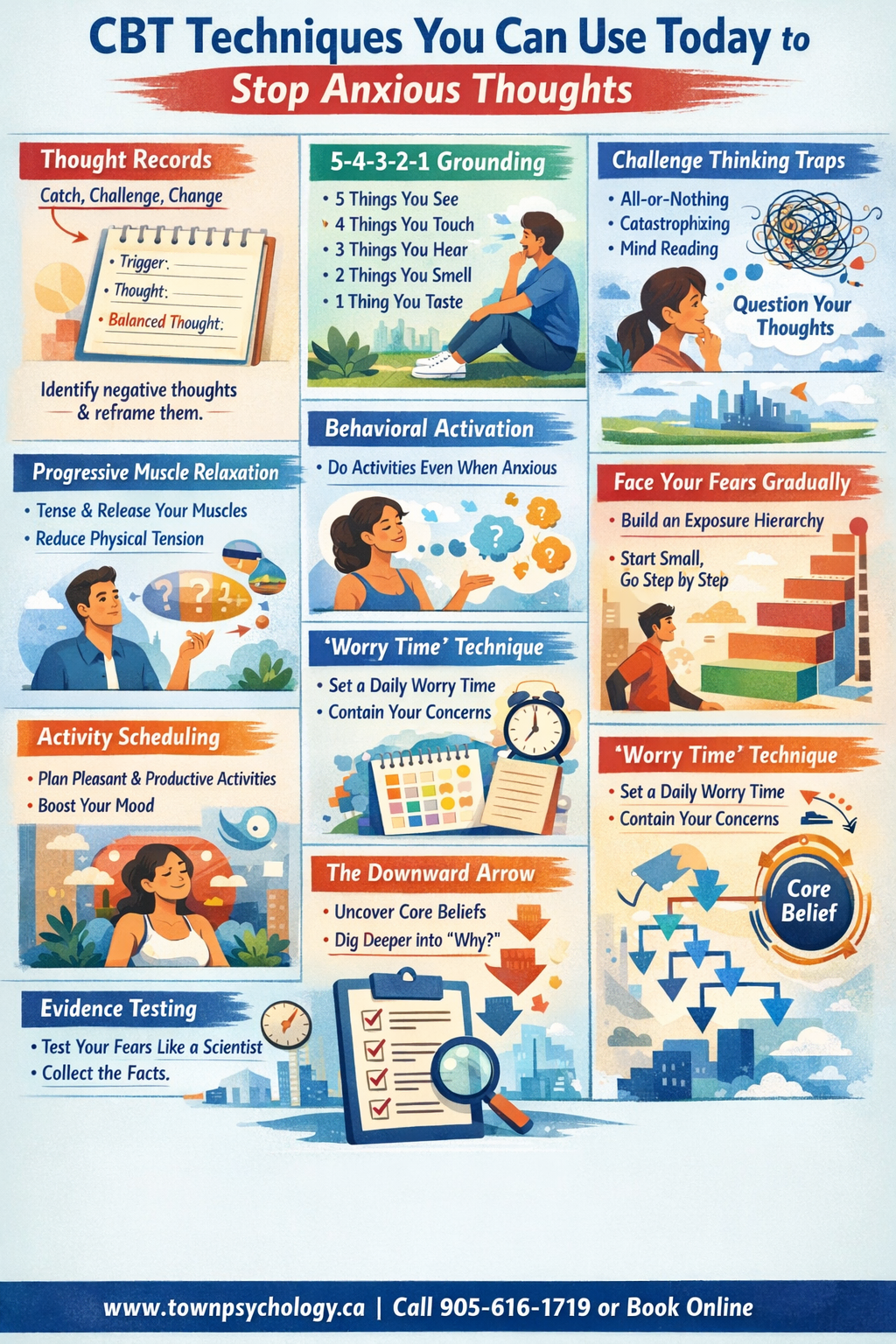
10 CBT Techniques to Quiet Anxious Thoughts Right Now
Below are 10 evidence-based CBT techniques you can implement today. While working with a experienced therapist yields the best results, these strategies can provide immediate relief and help you build long-term resilience.
1. Thought Records: Catch, Challenge, and Change
The foundation of CBT is understanding the connection between thoughts, feelings, and behaviors. Thought records help you identify automatic negative thoughts and examine them objectively.
How to do it:
- When you notice anxiety rising, write down the triggering situation
- Identify the automatic thought (“I’m going to fail this presentation”)
- Note your emotion and rate its intensity (1-10)
- Challenge the thought with evidence for and against it
- Create a more balanced thought (“I’ve prepared well and have succeeded before”)
- Re-rate your emotion
Example: Maria felt panicked before a job interview. Her automatic thought was “They’ll see I’m not qualified.” After recording her thoughts, she recognized she met all the job requirements and had relevant experience. Her balanced thought became “I’m well-prepared and my skills match what they need.” Her anxiety dropped from 8/10 to 4/10.
This technique works because it interrupts the automatic catastrophizing that fuels anxiety. Studies show that cognitive restructuring—the formal term for this process—produces medium to large effect sizes in treating anxiety disorders.
2. The 5-4-3-2-1 Grounding Technique
When anxiety triggers your fight-or-flight response, grounding techniques can bring you back to the present moment. This sensory awareness exercise is particularly effective for panic attacks.
How to do it:
- Identify 5 things you can see
- 4 things you can touch
- 3 things you can hear
- 2 things you can smell
- 1 thing you can taste
Why it works: Anxiety lives in the future (“What if…?”), while grounding anchors you in the now. By engaging your senses, you signal to your nervous system that you’re safe in this moment.
3. Cognitive Restructuring: Identify Your Thinking Traps
CBT identifies common cognitive distortions—systematic errors in thinking that maintain anxiety and depression. Learning to recognize these patterns is the first step to changing them.
Common thinking traps:
- All-or-nothing thinking: “If I’m not perfect, I’m a failure”
- Catastrophizing: “This headache is definitely a brain tumor”
- Mind reading: “They think I’m incompetent”
- Overgeneralization: “I failed once, so I’ll always fail”
- Emotional reasoning: “I feel anxious, so something bad must be happening”
How to challenge them: Ask yourself:
- What’s the evidence for this thought?
- Am I confusing a thought with a fact?
- What would I tell a friend who had this thought?
- Am I looking at the whole picture or just focusing on negatives?
This is a core component of Cognitive Behavioral Therapy, and research consistently shows it reduces symptoms in both anxiety and depression.
4. Behavioral Activation: Do It Anyway
When you’re anxious or depressed, avoidance feels protective. But avoiding activities actually maintains and strengthens anxiety. Behavioral activation means scheduling and engaging in activities even when you don’t feel like it.
How to do it:
- Make a list of activities you’ve been avoiding due to anxiety
- Rate them from least to most anxiety-provoking
- Start with the easiest item and commit to doing it this week
- Notice how you feel before, during, and after
- Gradually work up the list
Example: Jordan avoided social gatherings due to anxiety. He started by accepting a coffee invitation with one friend (3/10 anxiety), then attended a small dinner party (5/10), and eventually felt comfortable at larger events.
Behavioral activation is particularly powerful for depression, but it also breaks the avoidance cycle that maintains anxiety. A comprehensive meta-analysis found CBT produces medium to large effects (effect size of 0.79) compared to usual care.
5. Progressive Muscle Relaxation: Release Physical Tension
Anxiety doesn’t just live in your thoughts—it manifests as muscle tension, shallow breathing, and physical discomfort. Progressive muscle relaxation (PMR) systematically releases this tension.
How to do it:
- Find a quiet space and get comfortable
- Starting with your toes, tense the muscle group for 5 seconds
- Release and notice the sensation of relaxation for 10 seconds
- Move progressively up your body: feet, calves, thighs, abdomen, chest, arms, hands, neck, face
- Practice daily for 10-15 minutes
Why it works: PMR teaches you to recognize the difference between tension and relaxation. Over time, you become more attuned to early signs of anxiety and can release tension before it escalates.
6. Exposure Hierarchies: Face Your Fears Gradually
Avoidance strengthens fear. Exposure weakens it. But jumping straight into your biggest fear isn’t necessary or helpful. Instead, CBT uses gradual exposure through a hierarchy.
How to create your hierarchy:
- Identify your fear (e.g., public speaking)
- List 10 situations related to that fear, from least to most scary
- Rate each situation’s anxiety level (0-100)
- Start with the lowest-rated item
- Stay in the situation until your anxiety decreases by at least 50%
- Move up the hierarchy only when you can face the current level with minimal anxiety
Example hierarchy for public speaking:
- 10: Thinking about giving a speech
- 30: Writing a speech outline
- 50: Practicing alone in front of a mirror
- 70: Presenting to one trusted friend
- 85: Presenting to a small group of 3-5 people
- 100: Presenting to a large audience
Research on CBT for anxiety shows effect sizes ranging from 0.88 to 1.20 for different anxiety disorders—some of the strongest effects in psychotherapy research.
7. The “Worry Time” Technique: Contain Rumination
If you’re a chronic worrier, trying to “just stop worrying” doesn’t work. Instead, schedule your worry for a specific time each day.
How to do it:
- Choose a 15-minute worry window each day (e.g., 5:00-5:15 PM)
- When worries arise throughout the day, write them down and say “I’ll think about this during worry time”
- During your scheduled worry time, review your list and allow yourself to worry
- When the 15 minutes are up, stop and move on to another activity
Why it works: This technique gives you a sense of control over your worries rather than feeling controlled by them. Many people find that by the time worry time arrives, the concerns seem less urgent.
8. Activity Scheduling: Combat Depression Through Structure
Depression and anxiety often co-occur, and both can lead to inactivity that worsens symptoms. Activity scheduling creates structure and ensures you’re engaging in mood-boosting behaviors.
How to do it:
- Each week, schedule specific activities that include:
- Pleasant activities (things you enjoy)
- Achievement activities (things that give you a sense of accomplishment)
- Necessary activities (basic self-care)
- Start small—even 10 minutes counts
- Track your mood before and after each activity
- Notice patterns: which activities improve your mood most?
According to recent research, CBT for depression shows post-treatment effects of medium to large magnitude (effect sizes of 0.51 to 0.81), with benefits often maintained long-term.
9. The Downward Arrow: Uncover Core Beliefs
Sometimes anxiety stems from deeper core beliefs about ourselves or the world. The downward arrow technique helps you identify these underlying assumptions.
How to do it:
- Start with an anxious thought: “I can’t make a mistake in this presentation”
- Ask: “If that were true, what would it mean about me?”
- Answer: “It would mean I’m incompetent”
- Ask again: “And if that were true, what would it mean?”
- Answer: “It would mean I don’t deserve this job”
- Continue until you reach a core belief: “I’m not good enough”
Once you identify core beliefs, you can work on challenging and modifying them. This is deeper work often best done with a therapist, but awareness alone can be powerful. Our individual therapy services help clients explore and transform these core beliefs.
10. Evidence Testing: Treat Thoughts as Hypotheses
One of the most powerful CBT principles is treating anxious predictions as hypotheses to be tested, not facts to be believed.
How to do it:
- Identify an anxious prediction: “If I go to the party, I’ll have nothing to say and everyone will think I’m boring”
- Design a behavioral experiment to test it: “I’ll go to the party and track how many conversations I have and how people respond”
- Conduct the experiment
- Review the evidence: What actually happened?
- Update your belief based on evidence, not fear
Example: Chen predicted that if he spoke up in meetings, people would dismiss his ideas. He tested this by sharing one idea per week and tracking responses. After four weeks, he discovered that 3 out of 4 of his contributions led to productive discussions. His belief shifted from “My ideas aren’t valued” to “Some ideas land better than others, but I have valuable contributions to make.”
Research on CBT shows that 60% of adults receiving psychotherapy with CBT techniques report significant improvement, with approximately 70% expressing satisfaction with their treatment outcomes.
When Self-Help Isn’t Enough
These techniques are powerful tools, but they’re most effective when learned and practiced with guidance from a trained therapist. If you’re struggling with anxiety that interferes with daily life, professional support can make all the difference.
Consider professional help if:
- Your anxiety has lasted more than six months
- You’re avoiding important activities (work, relationships, health care)
- You’ve experienced panic attacks
- Anxiety is affecting your sleep, appetite, or concentration
- You’ve tried self-help strategies without improvement
Not sure if you need therapy? Take our free mental health quiz to gain insight into your symptoms and whether professional support might help.
At Town Psychological Services, our experienced therapists offer evidence-based CBT therapy both in-person in Oakville and online across Ontario. We’ll work with you to develop a personalized treatment plan that targets your specific anxiety triggers and builds lasting coping skills.
For more context on the science behind these techniques, read our guide on CBT principles.
Closing Thought
Anxiety feels overwhelming, but it doesn’t have to control your life. These 10 CBT techniques offer practical, evidence-based ways to interrupt anxious thinking and build resilience. Start with one or two that resonate most, practice them consistently, and notice what changes.
Remember: CBT isn’t about positive thinking or pretending everything is fine. It’s about examining your thoughts with curiosity, testing your assumptions, and making intentional choices about how you respond to anxiety.
If you’re struggling with persistent anxiety and want professional guidance in applying these techniques to your unique situation, reach out to our team. With the right support, anxiety can become manageable, and you can reclaim your sense of calm and control.
Ready to take the next step? Book a consultation with one of our CBT therapists today.
Frequently Asked Questions
How long does it take for CBT techniques to work for anxiety?
Many people notice some improvement within 2-4 weeks of consistently practicing CBT techniques, though the timeline varies by individual. Research shows that formal CBT therapy typically involves 12-16 sessions, with most people experiencing significant symptom reduction by mid-treatment. The key is consistency—practicing these techniques daily, even when you’re not feeling anxious, builds the neural pathways that make them more effective when you need them most. Self-directed CBT techniques can provide relief, but working with a trained therapist typically produces faster and more lasting results.
Can I use these CBT techniques on my own, or do I need a therapist?
You can absolutely start using these techniques on your own—many people find significant relief through self-directed practice. However, working with a CBT-trained therapist offers several advantages: they can help you identify which techniques are most relevant to your specific anxiety patterns, ensure you’re applying them correctly, address underlying core beliefs, and provide accountability and support. If your anxiety is severe, interfering with daily functioning, or hasn’t improved after several weeks of self-help, professional guidance through individual therapy is recommended. Think of these techniques as tools—you can use some tools effectively on your own, but a skilled therapist helps you build an entire toolkit customized to your needs.