

You’ve got your life together. You show up to work on time, your relationships are stable enough, and you’re not in crisis. So why would you need therapy?
Here’s the thing: therapy isn’t just a life raft for people who are drowning. It’s also a compass for people who want to navigate with more clarity, purpose, and resilience. If you wait until you’re in crisis to seek support, you’re missing out on one of the most powerful tools for living well—not just surviving.
Doing Fine? 5 Ways Individual Therapy Can Still Helps
Think of it this way: you don’t wait until your teeth fall out to see a dentist. You don’t skip annual physicals because you feel “fine.” So why treat your mental health any differently?
Let’s explore five ways individual therapy can enhance your life, even when everything seems manageable.
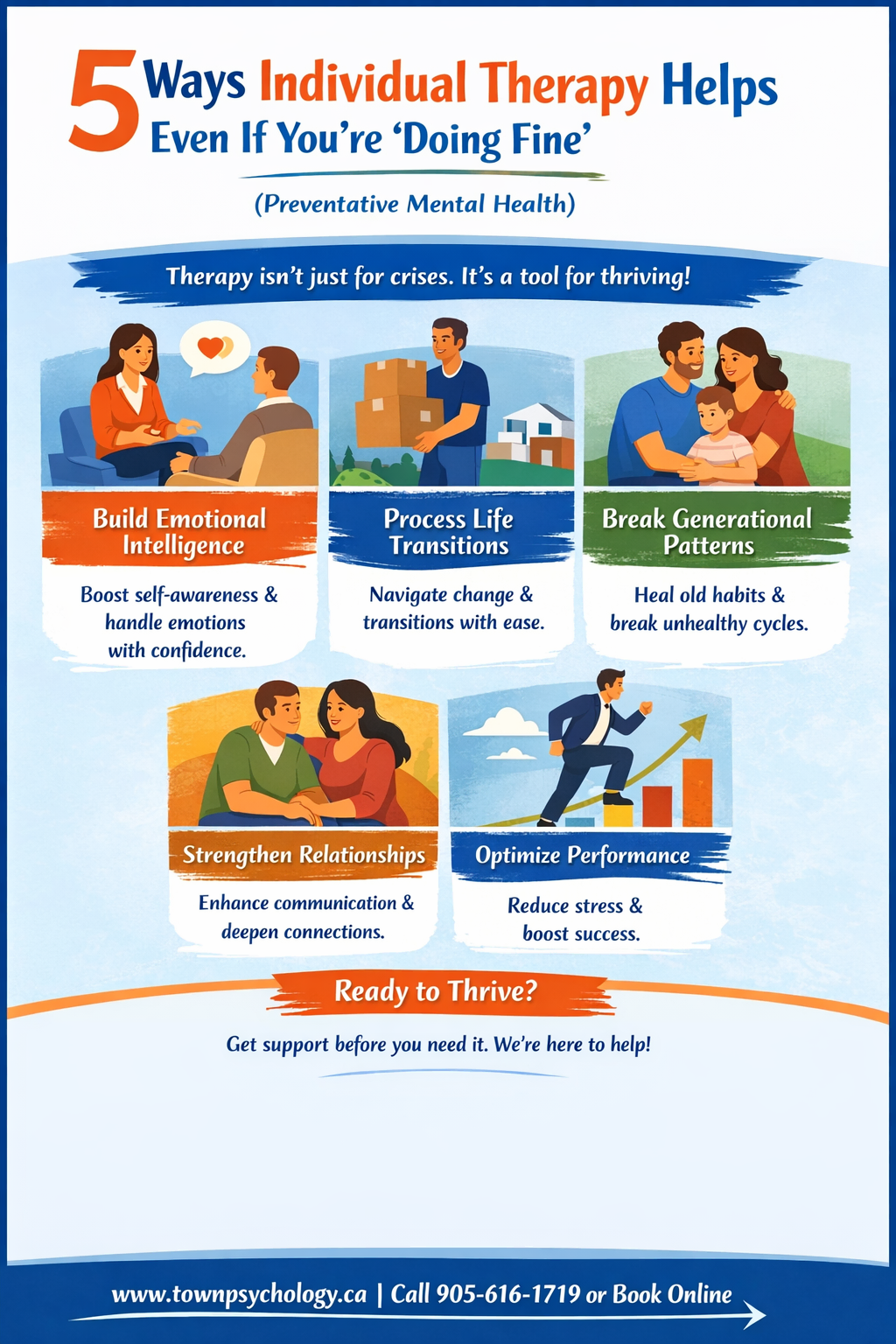
1. Build Emotional Intelligence Before You Need It
Emotional intelligence isn’t just a corporate buzzword—it’s the ability to recognize, understand, and manage your emotions and the emotions of others. Therapy gives you the space to develop this skill in a low-stakes environment.
In sessions, you learn to identify patterns in your reactions. Why does criticism from your manager send you into a spiral? Why do you shut down during conflict with your partner? A therapist helps you connect the dots between your past experiences and present responses.
The result? You become less reactive and more intentional. You handle difficult conversations with grace. You set boundaries without guilt. You show up as the version of yourself you actually want to be.
This kind of self-awareness doesn’t happen overnight, and it’s much harder to develop when you’re already overwhelmed. Preventative therapy gives you the tools before the storm hits.
2. Process Life Transitions Before They Turn Into Crises
Life transitions—even positive ones—are emotionally demanding. A new job. A move to a different city. Getting married. Becoming a parent. These milestones are celebrated, but they also come with stress, identity shifts, and unexpected challenges.
Without space to process these changes, they can accumulate. What starts as excitement about a promotion can morph into burnout. A new relationship can trigger old attachment wounds you didn’t know you had.
Therapy provides a structured space to work through transitions proactively. You can explore questions like: Who am I becoming in this new role? What values do I want to carry forward? What old patterns am I ready to release?
For professionals in the GTA juggling demanding careers and personal growth, virtual therapy makes it easier to prioritize your mental health without adding another commute to your day.
The bottom line: Therapy helps you ride the waves of change instead of being pulled under by them.
3. Break Generational Patterns You Didn’t Know You Inherited
You’ve probably heard the phrase “hurt people hurt people.” But what about the subtler patterns we inherit? The way your parent handled conflict. The messages you absorbed about vulnerability, success, or self-worth. The family scripts that dictate how you “should” live.
Many of us carry forward behaviors and beliefs that no longer serve us—not because we chose them, but because we absorbed them. Therapy illuminates these patterns so you can decide whether to keep them or create something new.
Maybe you realize you people-please because love felt conditional growing up. Maybe you avoid vulnerability because showing emotion was seen as weakness. Understanding these roots doesn’t erase the past, but it gives you agency over your future.
And if you’re a parent or planning to become one, this work is even more critical. Intergenerational trauma doesn’t have to be passed down. Therapy can help you break the cycle.
4. Strengthen Your Relationships While They’re Healthy
Most people only seek couples therapy near them when their relationship is on the brink. But what if you invested in your connection before resentment built up? What if you learned healthy communication skills before patterns became entrenched?
Individual therapy supports your relationships by helping you show up as a healthier partner, friend, or family member. You learn to communicate your needs clearly. You recognize when you’re projecting past wounds onto present situations. You develop the capacity to repair after conflict instead of letting things fester.
Even if you’re not in a romantic relationship, therapy improves how you relate to others. You learn active listening techniques that lower tension in any argument. You become more attuned to your impact on others.
Healthy relationships aren’t the absence of problems, they’re the presence of tools to navigate them. Therapy gives you those tools.
5. Optimize Your Performance and Well-Being
High achievers often resist therapy because they think it’s for people who are “struggling.” But peak performers in every field—athletes, executives, artists—invest in mental training because they know mindset matters.
Therapy helps you identify and challenge the thought patterns that hold you back. Maybe you’re a perfectionist who never feels “good enough.” Maybe you procrastinate because you fear failure. Maybe you burn out because you tie your worth to productivity.
A therapist can help you reframe these patterns using evidence-based approaches like Cognitive Behavioral Therapy (CBT) or Acceptance and Commitment Therapy (ACT). You’ll learn to manage stress before it becomes burnout, set realistic expectations, and find fulfillment beyond external achievements.
Preventative therapy isn’t about fixing what’s broken, it’s about optimizing what’s already working so you can thrive, not just survive.
Taking the First Step
If you’ve made it this far, chances are something resonated. Maybe you’re curious whether therapy could help, even if you’re “doing fine.”
Here’s the truth: you don’t need to be in crisis to deserve support. You don’t need a diagnosis to benefit from a space where you’re truly heard. And you don’t need to have it all figured out before you start.
Not sure if therapy is right for you? Take our free mental health quiz to gain insight into your emotional well-being. It’s confidential, takes just a few minutes, and can help you decide if professional support might be beneficial.
At Town Psychological Services, we offer compassionate individual therapy both in-person at our Oakville office and online across Ontario. Whether you’re navigating a life transition, looking to build emotional resilience, or simply want to show up as your best self, our team is here to support you.
Ready to invest in your mental health? Call 905-616-1719, or Book a consultation today. Your future self will thank you.