

When most people hear about EMDR therapy, they think of combat veterans or survivors of severe trauma. And while Eye Movement Desensitization and Reprocessing (EMDR) has proven remarkably effective for Post-Traumatic Stress Disorder—with research showing that up to 90% of single-trauma survivors no longer meet PTSD criteria after just three 90-minute sessions—the applications of EMDR extend far beyond what many realize.
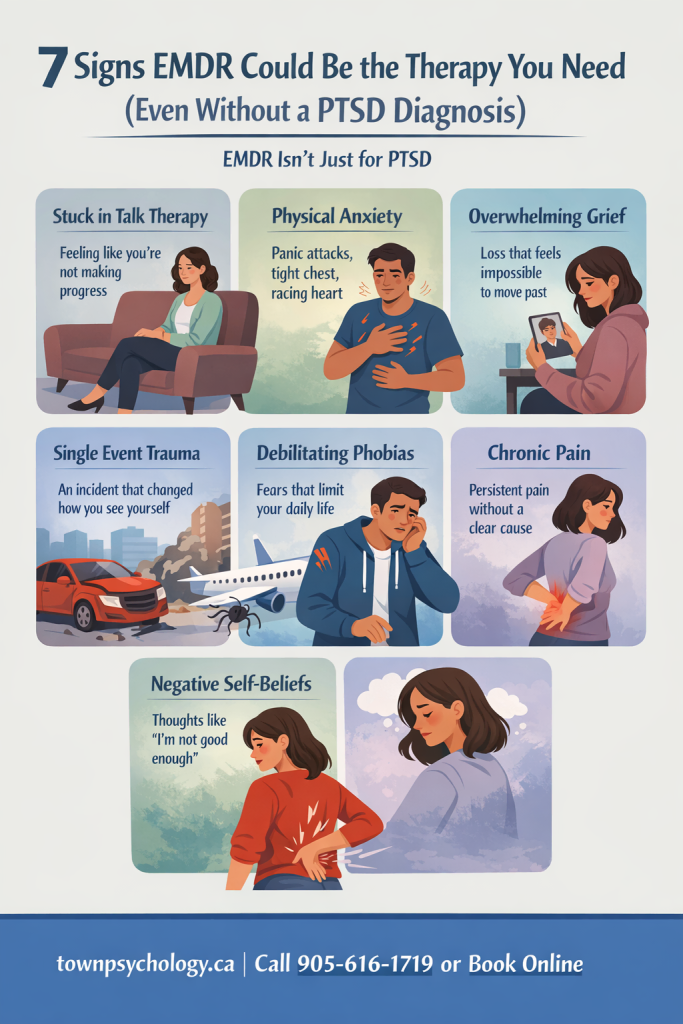
Seven Signs EMDR Could Be the Therapy You Need (Even Without a PTSD Diagnosis)
If you’re struggling with anxiety, grief, phobias, or even chronic pain, EMDR might be the breakthrough treatment you didn’t know you needed. Here are seven signs that EMDR therapy could be right for you.
1. You’re Stuck in Patterns That Talk Therapy Hasn’t Resolved
You’ve been in traditional therapy for months, maybe years. You understand why you react the way you do. You can articulate your triggers, identify your patterns, and explain your childhood wounds with impressive clarity. But somehow, you’re still stuck in the same loops.
This is where EMDR differs fundamentally from talk therapy. While Cognitive Behavioral Therapy (CBT) helps you challenge and reframe negative thoughts, EMDR works directly with how your brain stores traumatic memories. It doesn’t just change what you think about an experience—it changes how your nervous system responds to it.
Research published in the National Center for PTSD shows that EMDR achieves comparable results to CBT but often in fewer sessions, with lower dropout rates. If you’ve plateaued in traditional therapy, EMDR might be the missing piece.
What this looks like: You intellectually know you’re safe in your relationship, but your body still goes into fight-or-flight during conflict. You understand your childhood wasn’t your fault, but shame still floods you when you make a mistake.
2. Anxiety Feels Physical, Not Just Mental
Do you experience panic attacks seemingly out of nowhere? Does your chest tighten when you enter certain situations? Do specific sounds, smells, or places trigger intense physical reactions you can’t control?
These somatic responses often point to unprocessed trauma—even if you don’t identify with the word “trauma.” Maybe it was a medical procedure as a child, a humiliating experience in school, or a car accident you thought you’d “gotten over.”
EMDR is particularly effective for anxiety rooted in specific memories or experiences. The bilateral stimulation used in EMDR helps your brain reprocess these stored experiences, reducing the physiological activation that comes with them.
Signs EMDR could help:
- Panic attacks triggered by specific situations
- Hypervigilance or constant scanning for danger
- Physical symptoms (racing heart, nausea, sweating) when thinking about certain events
- Anxiety that feels “stuck in your body” rather than just your thoughts
If you’re curious whether anxiety is affecting you more than you realize, take our free mental health quiz to gain insight into your symptoms.
3. Grief Feels Overwhelming and Never-Ending
Grief is a natural response to loss, but sometimes it becomes complicated. Perhaps you lost someone suddenly, traumatically, or under circumstances that haunt you. Maybe you couldn’t say goodbye, or the loss triggered old wounds you thought were healed.
Complicated grief differs from typical mourning—it’s when the intensity doesn’t soften over time, when intrusive images of the death or last moments keep replaying, or when you can’t access happy memories without being flooded by pain.
Studies show that EMDR can successfully treat complicated mourning by helping your brain process the traumatic aspects of the loss separately from the relationship itself. This allows you to grieve in a healthier way and eventually hold both the pain of loss and the warmth of connection.
You might benefit from EMDR if:
- You avoid anything that reminds you of the person you lost
- Images from their death or final days intrude constantly
- Guilt or “what ifs” dominate your grief
- You feel emotionally numb or frozen in time since the loss
To learn more about how therapy supports emotional healing, read our blog on how to help someone with anxiety—many of the same principles apply to supporting yourself through grief.
4. A Specific Event Changed How You See Yourself
Sometimes a single event shatters our sense of safety or self-worth. A betrayal. An assault. A public humiliation. A medical diagnosis. An accident where you or someone else was hurt.
You might not have flashbacks or nightmares that fit the “classic” PTSD picture, but that event fundamentally changed you. You withdrew from activities you used to love. Stopped trusting people. You started believing something was wrong with you.
EMDR excels at targeting these specific incidents. In fact, research indicates that 100% of single-trauma survivors in some studies achieved remission from PTSD after just six 50-minute EMDR sessions—a remarkable success rate that speaks to EMDR’s efficiency when addressing discrete events.
Common “single-incident” traumas that respond well to EMDR:
- Car accidents or near-death experiences
- Medical trauma (difficult childbirth, surgical complications, ICU stays)
- Assault (physical or sexual)
- Witnessing violence or death
- Betrayal trauma (infidelity, being fired unjustly)
- Public humiliation or bullying incidents
Our EMDR therapy services are specifically designed to help you reprocess these memories and reclaim your sense of self.
5. Phobias or Fears Are Limiting Your Life
Not all fears need therapy, but when a phobia actively restricts your life—keeping you from flying to see loved ones, driving on highways, going to the doctor, or entering elevators—it’s time for intervention.
Phobias often have roots in specific experiences: a turbulent flight, a trapped elevator, a dog bite, a choking incident. Your brain encoded these as threats, and now it overreacts to protect you from perceived danger.
EMDR can reprocess the original sensitizing event, allowing your brain to recalibrate the threat level. Unlike exposure therapy, which requires you to repeatedly face your fear, EMDR works by changing how the memory is stored, often providing relief more quickly.
Phobias commonly treated with EMDR:
- Fear of flying
- Driving phobia (especially after accidents)
- Medical or dental phobia
- Claustrophobia
- Fear of dogs or other animals
- Fear of vomiting
- Social anxiety rooted in specific humiliating experiences
6. You Have Chronic Pain Without Clear Medical Cause
This one surprises many people, but research published in the National Institutes of Health shows that EMDR has an 80% success rate in eliminating or substantially reducing phantom limb pain—pain that has no current physical cause.
Why? Because pain memories can be stored in the same way as emotional trauma. If you suffered an injury in an accident, endured a painful medical procedure, or experienced chronic pain during a traumatic period, your nervous system may keep firing those pain signals even after the physical cause has healed.
EMDR has shown promising results for:
- Phantom limb pain
- Chronic pain following accidents or injuries
- Migraine headaches linked to stress or trauma
- Unexplained pain that medical tests can’t pinpoint
- Pain that worsens with stress or trauma reminders
If chronic pain is limiting your quality of life, individual therapy that includes EMDR may address both the physical and emotional components.
7. Negative Beliefs About Yourself Feel Unshakeable
“I’m not good enough.”
“I’m unlovable.”
“It’s not safe to be me.”
“I can’t trust anyone.”
These core negative beliefs often form during difficult experiences—sometimes ones you don’t even consciously remember. EMDR doesn’t just challenge these beliefs cognitively; it targets the experiences that created them.
During EMDR, you’ll identify the negative cognition attached to a memory (e.g., “I am powerless”) and work toward installing a more adaptive belief (e.g., “I now have choices”). The bilateral stimulation helps your brain integrate this new perspective at a deeper level than positive affirmations or cognitive restructuring alone.
You might benefit from EMDR if:
- Negative self-beliefs feel viscerally true, not just like “negative thoughts”
- You struggle with shame that feels disproportionate to your actions
- You have a persistent sense of being fundamentally flawed or broken
- Your self-worth collapses easily under criticism or perceived rejection
Understanding the roots of negative self-perception is explored further in our blog on understanding intergenerational trauma, which examines how beliefs can be passed down through families.
Is EMDR Therapy Right for Me?
EMDR isn’t just for severe PTSD. It’s for anyone whose past continues to interfere with their present. It’s for the person who white-knuckles through every flight. The parent who panics when their child is five minutes late. The professional who freezes during presentations because of one humiliating experience years ago.
The evidence is clear: EMDR works. Studies involving veterans show a 77-78% elimination of PTSD diagnosis after 12 sessions. Research on earthquake survivors demonstrates that 92.7% successfully eliminated PTSD after just five sessions. And the treatment gains are lasting—follow-up studies at 3, 15, and even 36 months show that the benefits endure.
If any of these seven signs resonated with you, it might be time to explore EMDR. You don’t need to be “traumatized enough” to deserve healing. You just need to be ready to process what’s been holding you back.
Ready to learn more? Read our comprehensive guide on EMDR therapy near me or book a consultation with one of our EMDR-trained therapists in Oakville or online across Ontario. Your past doesn’t have to dictate your future. With the right support, healing is possible.