
Trauma leaves a mark that doesn’t disappear on its own. Whether it stems from a single overwhelming event or years of chronic adversity, the effects of trauma can show up in your body, your relationships, and every aspect of daily life. For adults in Ontario struggling with Post-Traumatic Stress Disorder (PTSD) or complex trauma, finding the right therapy is one of the most important steps toward recovery.
You may have already heard about EMDR or Cognitive Processing Therapy (CPT) as frontline trauma treatments. But there is another powerful, evidence-based option that is especially effective for adults who experience intense emotions alongside trauma: Dialectical Behaviour Therapy (DBT).
This post explains how DBT helps adults with trauma and PTSD, what the research says, and how you can access DBT therapy in Ontario.
What Is the Connection Between Trauma, PTSD, and Emotional Dysregulation?
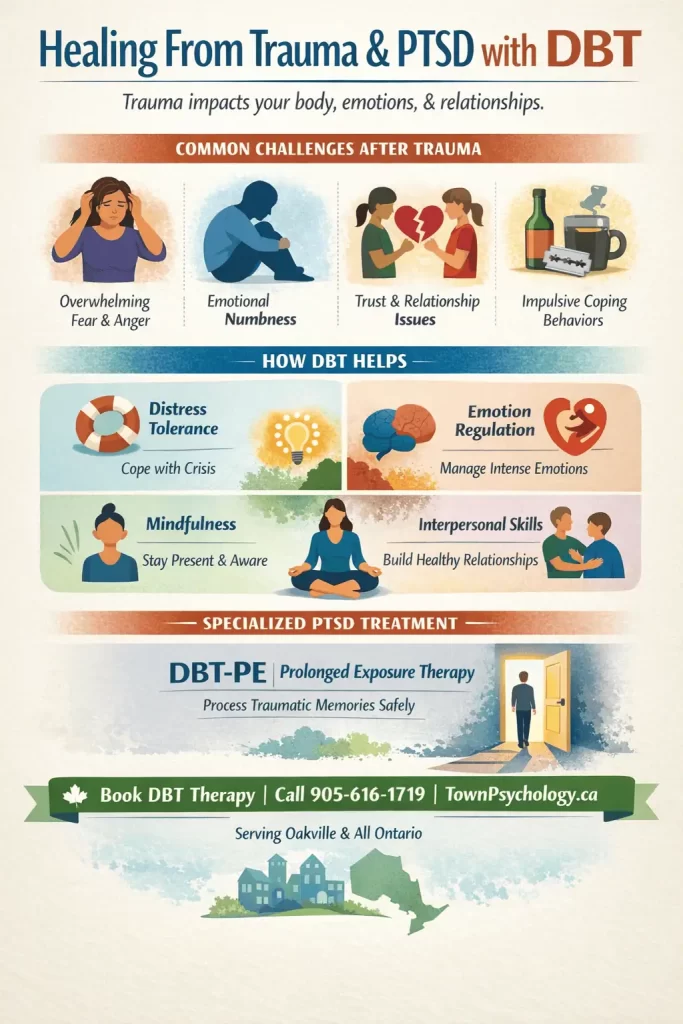
PTSD is more than flashbacks and nightmares. For many adults, trauma profoundly disrupts how they experience and manage emotions. Common emotional challenges that follow trauma include:
- Sudden, overwhelming waves of fear, shame, or rage
- Emotional numbness or feeling disconnected from yourself
- Difficulty trusting others or maintaining relationships
- Impulsive behaviours used to cope with distress — such as substance use, self-harm, or avoidance
- Chronic feelings of emptiness or hopelessness
This overlap between trauma and emotional dysregulation is exactly why DBT is such a valuable treatment option. DBT was specifically designed to help individuals who experience emotions intensely and who struggle to regulate them effectively. When trauma is at the root of that emotional intensity, DBT addresses both simultaneously.
DBT for Trauma and PTSD: How Dialectical Behaviour Therapy Helps Adults Heal in Ontario
Standard DBT builds a foundation of four core skill sets that are directly relevant to trauma recovery:
1. Distress Tolerance
Trauma survivors are often thrown into crisis by triggers — reminders of past events that activate intense distress. Distress tolerance skills teach you how to survive these moments without making things worse. Rather than turning to avoidance or harmful coping behaviours, you learn grounded, practical tools to get through the storm.
2. Emotion Regulation
Trauma rewires the nervous system. Emotion regulation skills help you understand what emotions are, why they happen, and how to reduce their intensity over time. For adults with PTSD, this means fewer emotional crashes and more stable day-to-day functioning.
3. Mindfulness
Trauma often pulls people either into the past (flashbacks, rumination) or into emotional shutdown. Mindfulness skills train the mind to return to the present moment with awareness and without judgment — a foundational capability for trauma healing.
4. Interpersonal Effectiveness
Trauma frequently damages the ability to trust, set boundaries, and feel safe in relationships. Interpersonal effectiveness skills help you rebuild healthy relational patterns — communicating needs clearly, navigating conflict, and forming connections that feel secure rather than threatening.
DBT-PE: The Specialized Protocol for PTSD
For adults whose primary concern is PTSD, there is a specialized and powerful treatment called DBT-PE — Dialectical Behaviour Therapy with Prolonged Exposure. Developed by Dr. Melanie Harned, DBT-PE integrates the emotional stabilization skills of standard DBT with a structured Prolonged Exposure protocol to directly process traumatic memories.
The logic behind DBT-PE is straightforward: trauma processing requires a person to tolerate confronting distressing memories without shutting down or spiralling into crisis. Standard DBT first builds that tolerance capacity. Once a client is stable enough, the PE phase directly targets the trauma itself.
Research supports this approach. Clinical studies have shown that DBT-PE significantly reduces PTSD symptoms, suicidal ideation, and self-harm behaviours in adults with both PTSD and significant emotional dysregulation. It is particularly well-suited to adults who have not responded fully to other trauma treatments, or whose emotional instability has made trauma processing feel unsafe in the past.
Who Is DBT for Trauma Right For?
DBT-informed trauma therapy may be the right fit if you are an adult who:
- Has a diagnosis of PTSD or experiences trauma-related symptoms
- Struggles with intense, unpredictable, or overwhelming emotions
- Has a history of self-harm, suicidal thoughts, or impulsive coping behaviours
- Meets criteria for Borderline Personality Disorder (BPD) alongside PTSD, a frequent co-occurrence
- Has tried other trauma therapies but found the emotional intensity too difficult to manage during processing
- Is dealing with complex or repeated trauma (childhood abuse, domestic violence, chronic adversity)
It is worth noting that DBT for trauma is designed for adults. If you are seeking support for a young person under 18, please speak with a provider who specializes in trauma-focused therapy for youth.
DBT vs. Other Trauma Therapies: How Does It Compare?
Town Psychological Services offers several evidence-based trauma treatments. Understanding the differences can help you make an informed decision:
- EMDR (Eye Movement Desensitization and Reprocessing): A highly effective trauma treatment that uses bilateral stimulation to help the brain process traumatic memories. Best suited for adults who are emotionally stable enough to engage in memory processing. Learn more about EMDR therapy.
- CPT (Cognitive Processing Therapy): A structured cognitive therapy that helps individuals identify and challenge unhelpful beliefs formed as a result of trauma. Particularly effective for PTSD following single-incident traumas. Learn more about CPT therapy.
- DBT for Trauma: The most appropriate choice for adults whose trauma has resulted in severe emotional dysregulation, self-harm, BPD symptoms, or multiple co-occurring mental health challenges. DBT builds stability first, making trauma processing safer and more sustainable.
Your therapist will conduct a thorough assessment to determine which approach — or combination of approaches — best matches your needs and goals.
What Does DBT Trauma Therapy Actually Look Like?
At Town Psychological Services, DBT is delivered in a structured, supportive format:
- Individual therapy sessions focus on your specific trauma history, emotional patterns, and current life challenges. Your therapist will help you use DBT skills in real situations and guide you through the trauma processing phase when you are ready.
- DBT Skills Group provides a structured environment to learn and practise the four core skill modules alongside other adults — a format shown to accelerate skill acquisition.
- Phone coaching may be available between sessions to support you in applying skills during difficult moments.
Sessions are available in-person at our Oakville office and virtually throughout Ontario, making DBT accessible regardless of where you live in the province.
DBT for Trauma in Ontario: What You Need to Know
Private DBT therapy in Ontario does not require a doctor’s referral. You can self-refer directly by contacting our team. Many extended health benefits plans cover sessions with registered psychologists and psychotherapists — check your plan details or contact us and we can help you understand your options. Wondering about cost? Visit our fees page for up-to-date information on session rates.
Ready to start healing from trauma? Our registered psychologists and psychotherapists at Town Psychological Services specialize in DBT for trauma and PTSD. We offer in-person sessions in Oakville and virtual therapy across Ontario.
Book Your DBT Therapy Session Today | Call 905-616-1719
Final Thoughts
Trauma is treatable. With the right therapeutic approach, adults can move beyond survival mode and build a life that feels meaningful and connected. DBT offers a unique path for those whose trauma has come with intense emotional pain — a path that prioritizes safety, skill-building, and gradual, sustainable healing.
If you have been struggling with PTSD, complex trauma, or emotional dysregulation and are looking for trauma therapy in Ontario, we encourage you to reach out. Our team is here to help you take the first step.
Disclaimner: This blog is for informational purposes only and does not constitute clinical advice. Please consult a qualified mental health professional to determine the most appropriate treatment for your individual needs.
Frequently Asked Questions
DBT was originally developed to treat Borderline Personality Disorder (BPD), but its application has expanded significantly. Research now supports DBT — and its specialized extension, DBT-PE (DBT with Prolonged Exposure) — as an effective treatment for PTSD in adults, particularly those who experience intense emotional dysregulation alongside trauma symptoms.
DBT-PE was specifically designed to help adults who have not been able to safely engage in standard trauma processing due to emotional instability, self-harm, or co-occurring BPD. If you are wondering whether DBT therapy is the right fit for your trauma history, our clinicians at Town Psychological Services can conduct a thorough assessment to guide you.
All three are evidence-based trauma treatments, but they work differently and suit different needs. EMDR uses bilateral stimulation to help the brain reprocess traumatic memories and is particularly effective for adults who are emotionally stable enough to engage in memory work directly.
CPT uses structured cognitive exercises to challenge unhelpful beliefs formed as a result of trauma, making it a strong option for single-incident PTSD.
DBT for trauma is best suited for adults whose PTSD is accompanied by severe emotional dysregulation, self-harm, or complex/repeated trauma.
Rather than beginning with memory processing, DBT first builds the emotional and behavioural stability needed to make trauma work safe and sustainable. Your therapist will help determine which approach — or combination — fits your situation best.
You do not need a doctor’s referral to book DBT therapy at a private practice in Ontario. You can contact Town Psychological Services directly to schedule an intake appointment. That said, if you plan to submit therapy fees to your extended health benefits plan or insurance provider, some plans may require a referral for reimbursement purposes — so it is worth checking your policy in advance. OHIP does not cover private psychotherapy, but many employer benefit plans and Employee Assistance Programs (EAPs) provide partial or full coverage.